

2,033 Law Enforcement Contracts Feeding the Deportation Machine
A high mark (and low point) in ICE's dangerous, out-of-control police partnership program.

As of Monday, June 22, 2026, there are over 2,000 active 287(g) agreements according to ICE’s program website. More than 1,700 unique agencies now participate — roughly 9.5% of all law enforcement agencies in the United States.1
In just 16 months, over 1,500 local police departments, county sheriffs’ offices, state highway patrols, and other LEAs have joined the immigration enforcement partnership program. And it’s all managed by the ICE component subagency, Enforcement & Removal Operations (ERO), that’s also responsible for:
overseeing the immigration detention system2, which marked its 20th death of 2026 this week when 63-year old Felix Alcorta-Rodriguez passed away in Texas.
detainee custody transfer and removal operations, like the daily flights moving ICE detainees between different processing + detention facilities, and the other set of daily deportation flights.3
enforcement operations4, including community-based abductions, coordinated arrests with local police, and other ‘first mile’ intake activity for the deportation machine.
Here’s how I described the deportation machine’s basic flow recently:
Think of it as a funnel, where the larger top end represents the intake into the detention and deportation system — primarily through arrests and jail detainer requests. At the smaller bottom of the funnel, we have the ultimate goal of this machine as it is currently configured by Stephen Miller and Tom Homan: remove as many individuals as possible.

And we now have some (messy and incomplete) data showing how the program’s growth correlates with ICE’s broader arrest numbers since last January. As I wrote in that same piece above:
So, the overall composition in ICE arrests has shifted dramatically over the past year, with 287(g) related arrests representing nearly 10% [9.5%] of arrests in January and February 2026, up from less than 3% [2.9%] in early 2025.
With a new peak in both active agreements (2,033) and participating agencies (1,731), I figured we’d take the opportunity to review some recent updates to the report, all intended to help us understand how this program fits into ICE’s larger deportation machine.

So Fresh, So Clean
First: I’m currently working through a design sweep to fix some weird font sizes, formatting issues, etc. across the report pages/sections. I’m also working to make the report, as well as the website landing page, easier to use across mobile and desktop views.
As the first stage of this work, I’ve revamped the dashboard page, which I hope is a slightly more useful summary of key programs stats + trends, without adding too much extra noise.
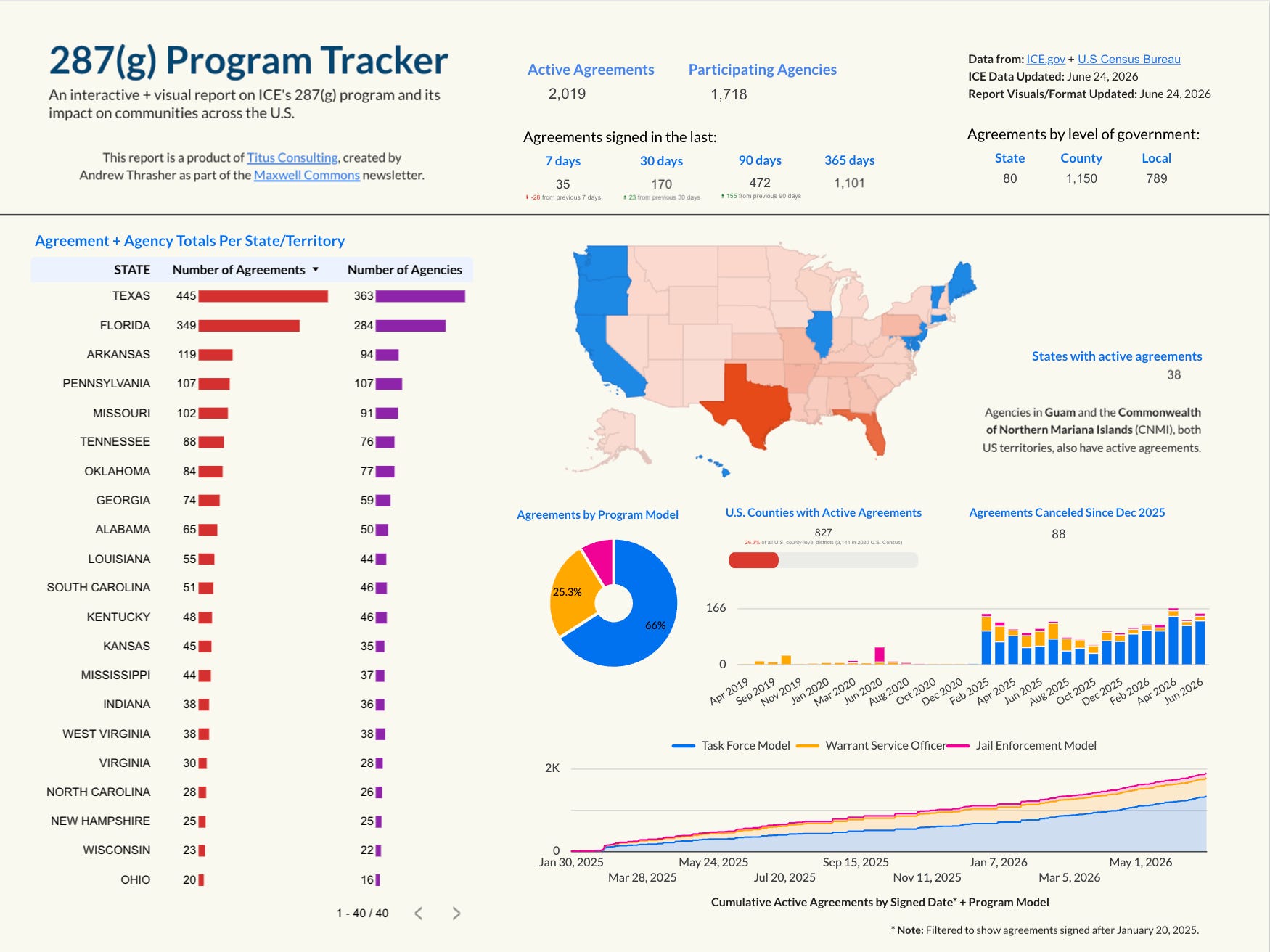
Next, I’ll be adding nav links on these charts to jump directly from the overview to the relevant report page/section for more detailed analysis. And thanks to some great feedback from several journalists in the audience, I’m also working to add more user-based controls to simplify filtering across report visuals — e.g., for state-level or program model analysis.
A site for cites and other such sights
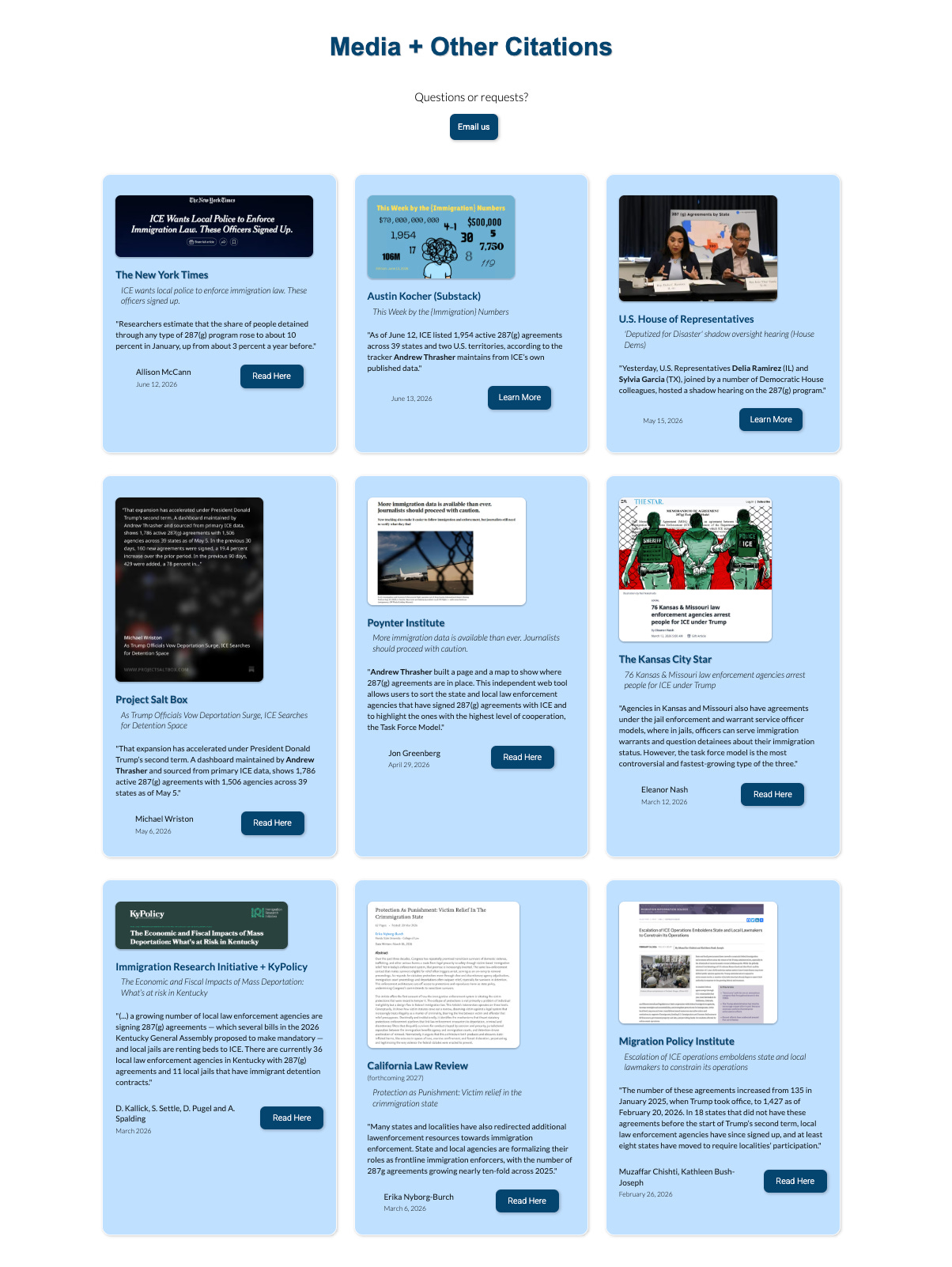
Speaking of journalists, I’ll use this as an opportunity to show off another set of updates, on the landing page + resource hub. Over the past few months, this newsletter and report have been cited in policy papers, newsletters, newspapers, and even Congress! As I wrote recently, it’s evidence that we are, in fact, making noise.

With that in mind, I’ve started documenting the noise in a new ‘Media Reports + Citations’ section of the landing page. Of course, please let me know if I’ve missed any references, or if you come across any new ones.
Goals.
As I mentioned to Austin Kocher in this conversation from February, one of the main goals of this whole thing is to turn obscure, low quality, and generally difficult-to-use data from ICE into a publicly-accessible report.

Why? The 287(g) program is now a multi-billion dollar slush fund operation, with nearly 10% of U.S. law enforcement agencies participating today. Yet, the only (proactive) accountability from ICE and the Department of Homeland Security is a simple Excel spreadsheet tracking bare-minimum contract details, and made largely unusable due to typos and other data quality issues.
Anyways, I’d like to think we’ve made progress toward that goal I mentioned…


Live, and Learn, Más
Interactive visual report aside, there’s a lot more to this program than just big picture numbers. Data visualization isn’t much help for explaining how the scope of enforcement authority differs between the three program models, for example.
That’s why I’m also working to expand the About the Report + Learn More sections of the landing page to:
answer more of the common questions on how the 287(g) program works;
give more background context on where the data comes from and how it’s used in my report;
share some curated recommendations for further reading + learning about the program.


As I work to expand these areas, I’m also going to add some simple infographics and diagrams to help explain complex concepts, compare program models, etc.
And, to revisit the goals thing for a second: I’d love to see this page evolve into a true public resource hub. Or, as this newsletter’s name alludes to, an information commons — founded in Chicago, and inspired by the city’s Maxwell Street market. The Maxwell Commons, if you will.
Support the report
Candidly: while we’ve certainly been making noise, we haven’t been making money on this thing.
That’s not necessarily a goal for this kind of project by any means, but it does take a toll as the work has grown more resource intensive. I’d also like to think the list of citations we’ve built up speaks to the value it’s already provided. Meanwhile, I’m also working on several projects where revenue is a goal (more to come there soon). Oh, and did I mention I’m self-employed?
With that said, I’ve also added a ‘Support the Work’ section to the report page:
If you’ve found value in this newsletter, whether for work or personal purposes, please consider upgrading to a paid subscription. And while I don’t put any newsletter content behind a paywall, please stay tuned for some new (tangible) extras for paid subscribers, coming very soon.
For anyone who’d like to support the work, but prefers to avoid Substack, ongoing subscriptions, etc., I’ve also added a Buy Me a Coffee link to the report page.
Finally: financial support isn’t the only way to help! Whether it’s following along on social media, resharing newsletter posts, or otherwise just getting involved locally, your support is appreciated.
Keep making noise.
Using a rounded total of 18,000 law enforcement agencies nationally, a rounded (upward) estimate from the 17,541 agencies cited in this 2018 Census of State and Local Law Enforcement Agencies, published in 2022 by the DOJ’s Bureau of Justice Statistics.
I use ‘oversee’ here because almost all of ICE’s immigration detention capacity is actually fulfilled through contracts with the private prison giants (CoreCivic and GEO Group), local + county jails, state prisons, and other government agencies with detention facilities.
For more on the ICE detention system, check out:
Deportation Data Project, which ‘obtains, posts, and analyzes internal U.S. government immigration enforcement data via public records litigation.’
DetentionReports.com is a facility-level report on average detention population, detainee demographics, ICE contract details, etc.
Austin Kocher’s Substack newsletter, where he routinely covers the numbers behind (and the stories of people impacted by) the ICE detention system.
For more on ICE removal and transfer flights:
Habeas Flight Watch dashboard – monitoring daily ICE transfer and removal flights to inform legal teams re: venue for habeas corpus petitions.
See the ICE Flight Monitor from Human Rights First
ICE Air Deportation Flights from University of Washington’s Center for Human Rights
Homeland Security Investigations (HSI), another ICE component subagency, also takes on enforcement work, both as separate investigations and in collaboration with ERO (and partner law enforcement).