

Mis-Immigration, and the Information Crisis Behind ICE's Growth

On January 6th, 2025, I sent a long-winded email to several business advisors with my thoughts on the upcoming inauguration, our broken immigration system, and how we might push back against the ‘us v. them’ dehumanization campaign from Stephen Miller, et al.
As I wrote at the time:
“(…) I will admit that I’m scared. I’m scared for what this administration is capable of, and also for what it’s not capable of. The few adults who were still in Trump’s circle in 2020 won’t be in the room this time around—the clowns have officially taken over the circus.
But I’m stubborn by nature, and my personal frustration has unlocked more clarity on where I can help fight back. Education and knowledge-sharing will be more important than ever to drown out (and devalue) the stream of misinformation.”
That email, in turn, was partly inspired by an altercation several months earlier, on LinkedIn of all places, which started with the heinous post shown in the screenshot below. The post was written by a well-known ‘immigration litigation’ lawyer who specializes in suing the government on behalf of clients seeking employment-based and investment-based immigration benefits.
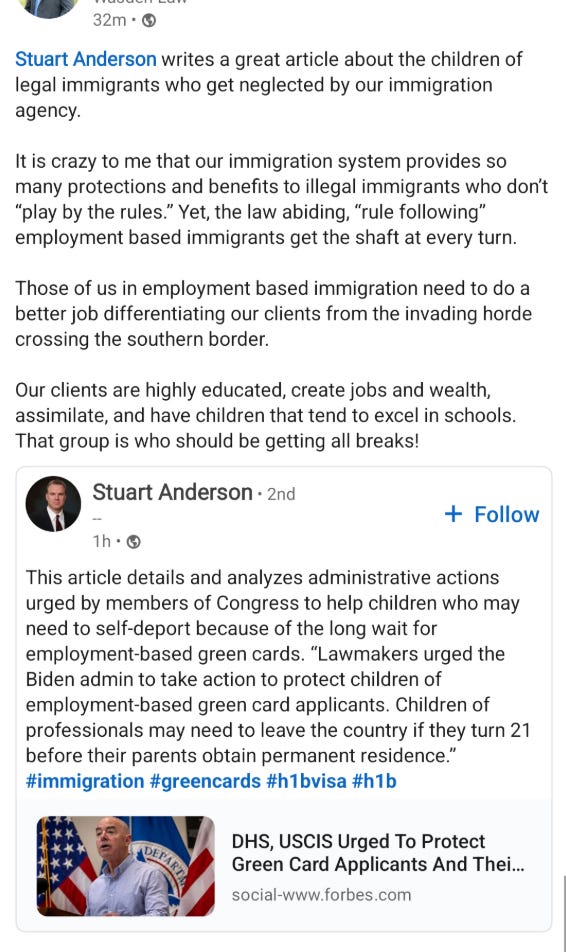
Of course, this attorney — who previously worked for our federal government, and now in private practice — is very aware that his bigoted garbage was both racist and factually wrong. So I’ll be very clear: there is no direct competition for immigration benefits between this attorney’s clients and the “invading horde” he refers to (I’m very tempted to name him openly here for this alone).
In fact, the issue identified in Stuart Anderson’s original post, like so many of the problems plaguing this broken system, is really the result of Congressional inaction. There just aren’t enough visas available each year, across all the different categories of admission, from temporary (‘nonimmigrant’) work visas to family-based green cards.
But this is not a zero-sum game.
Our immigration system is broken in many ways, and for many reasons. But it is not broken because of some supposed win/lose battle between classes of people, pushed by this attorney and others — some of whom stand to benefit directly from keeping this system broken.
It’s a narrative that conveniently ignores the history of our immigration system at large, the political realities in Congress, and the impact of our own foreign policy, climate change, and other factors on international migration. Because when you consider those things, it becomes painfully obvious that the people navigating this broken system aren’t to blame.
What a broken system looks like
The first DACA case I worked on was for a teenager with cancer from Mongolia. We’ll refer to her as Narantuya for the purposes of this story.
The Line That Doesn’t Exist
Yesterday, Aaron Reichlin-Melnick, a senior fellow at the American Immigration Council, posted the following on BlueSky:
In response to Aaron’s post, and the Texas Observer article he reshared — about an immigration court interpreter who was recently arrested by ICE — someone replied:
”She is being treated horribly. But how do you live in a country for 35 yrs without becoming a citizen?”
As Aaron notes in his response, there is often no viable path to permanent status or citizenship for the millions of neighbors without documentation. You can’t just wait in line when that line doesn’t exist, and the Line Organizer (Congress) won’t create one for you. That’s the case for millions of people right now.
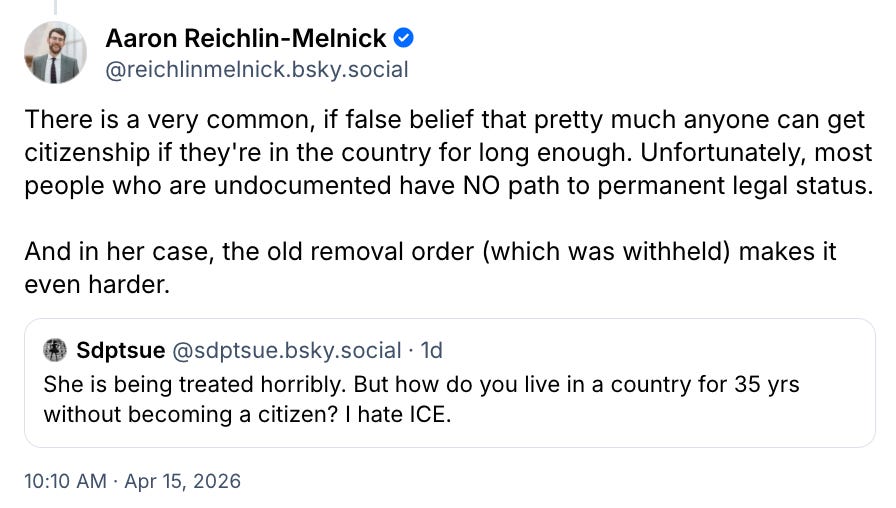
”There is a very common, if false belief that pretty much anyone can get citizenship if they’re in the country for long enough. Unfortunately, most people who are undocumented have NO path to permanent legal status.
And in her case, the old removal order (which was withheld) makes it even harder.”
Even if you are fortunate enough to have a line to wait in, it’s not guaranteed it will remain open — as hundreds of thousands of individuals with Temporary Protected Status (TPS) have learned over the past 14 months. And if you are fortunate enough to maintain your place in one of these lines, and make it to the front, you’ve likely waited years or even decades to get there.
As I said in response to the exchange, this is one of the more common (and dangerous) misunderstandings the average person in the U.S. has about our immigration system. Even for those with valid visa status and documentation, the wait time for a green card (let alone naturalized citizenship) can easily take more than a decade.
And while this particular myth isn’t necessarily based in racist bigotry like the ‘invading horde’ mindset, it’s still dangerous in how easily it flips the narrative against the people stuck in this system.
Immigration Goes Local
I started my visual report on ICE’s 287(g) program after the initial surge in agreements signed last spring. The way I saw it: if the Trump regime is determined to build their deportation machine by pushing 287(g) on local policing, it’s critically important to document who is responsible for the decisions behind each of these agreements.

But by forcing federal immigration policy on local communities, and incentivizing police and sheriffs’ offices to join, I also see this program as one of the better “bang-for-your-buck” ways to fight back against draconian immigration enforcement at the local level.

And while Congress has managed to ignore actual system reform for 30 years now, this community-level action is a rare opportunity to reaffirm our commitment to a more fair and open immigration system locally, and challenge the prevailing narratives in D.C.
With a heavy dose of bias, I also think this is why the list of canceled 287(g) agreements in my report is important. While ICE tries to quietly remove these agreements from the agency’s published record, the cancelations often represent a community’s successful fight against federal overreach and violent law enforcement. That alone deserves proper documentation. But I’m also intrigued by what we can learn from how these communities pushed back. More on this soon.
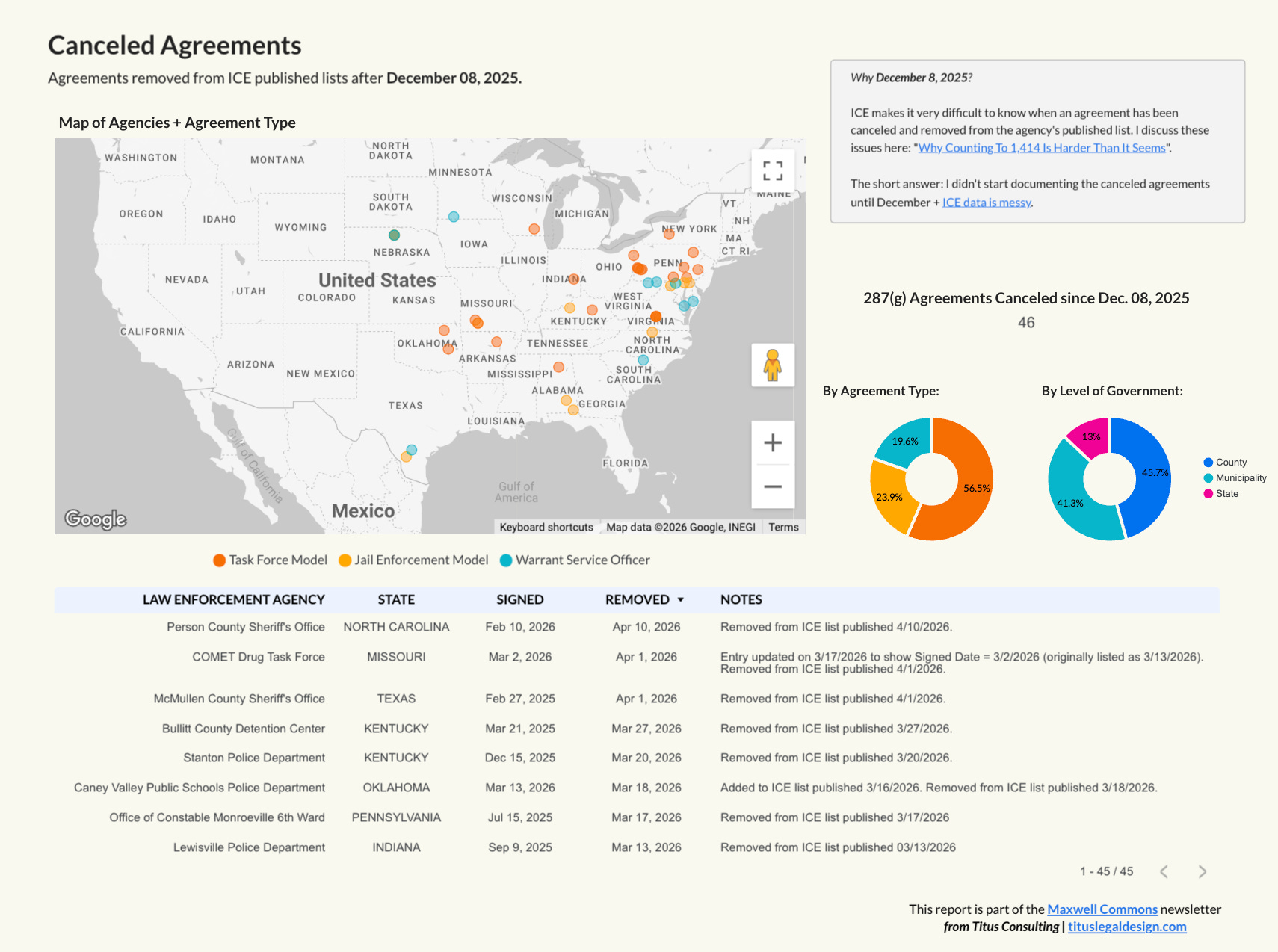
In the meantime, you can find a map and timeline for the 46 agreements that have been canceled since December 2025 here.
I also recommend checking out Dallin Overstreet’s PoliMetrics newsletter and visual report, breaking down the key factors behind recent 287(g) policy diffusion at the local and county levels.

Drowning Out the Misinformation
Here is my initial response to the attorney who wrote the ignorant, racist LinkedIn post I mentioned earlier:
“Or we can refrain from using a misleading ‘us vs. them’ dichotomy on such a broad policy area. Disappointed to see this type of language used by a well-respected attorney, reducing large populations of people with complex motivations and needs to an ‘invading horde’. Imo, you can advocate for your clients perfectly well without turning to this.”
Before he eventually blocked me and deleted my comments from his post, he also had the nerve to include this Elon Musk-style nonsense in one of his responses:
“Personally in a high tech economy I don’t want large influxes of cheap uneducated workers. I want the highly skilled and well educated. That’s the key to surviving at the top as a nation.”
Now, I want to be clear that most immigration law professionals do not think like this particular jackass. But there are certainly some who do — a reminder that even those working inside the broken system aren’t immune to the lies it perpetuates.
So, as I said in that email to advisors last January: education and knowledge-sharing is more important than ever to drown out (and devalue) the stream of misinformation. With that said, please consider this post the start of a new series of articles on the prevalent myths and misunderstandings (and historical context) that led us to our current ‘mis-immigration’ crisis.