

Proceed with Caution
On data and trust, from a random guy with a laptop in Chicago

In late April, my 287(g) program report was highlighted by Jon Greenberg at the Poynter Institute, in a piece covering the new crop of tools for timely and useful data on immigration enforcement and DHS operations.

Admittedly, the title of the article, “More immigration data is available than ever. Journalists should proceed with caution.” doesn’t sound like the setup for a raving review. But when you consider the source, that’s kind of the point. If you’re not familiar, Poynter is a nonprofit resource hub for community-based journalism.
The article is essentially a reference guide for journalists covering new and uncharted territory — and navigating with an equally-new set of tools. So to see my report mentioned alongside an incredible list of people and organizations, each working to shine light on the various components of the mass deportation machine, was an honor.
Through teaching, publishing, convening, fact-checking and media literacy, Poynter creates a crossroads where communities come together to use journalism to confront society’s complex problems.
In the piece, Greenberg highlights how my report1 connects back to my work background and expertise, this newsletter, etc. He also mentions how this context wasn’t particularly clear when he first came across the report and reached out to me.
He was kind enough to share some feedback on how to better connect this project back to my professional profile, as a way to build trust with an audience of journalists. As Greenberg referred to it in his initial email, my report has become part of the “public service interface” on the 287(g) program.
He is well-versed in the challenges of working with data, and with the zeal of a jigsaw puzzle fan, he writes about how the ICE 287(g) data is rife with glitches.
Thrasher said he knows the site needs more transparency. It’s still evolving, and he said he is “working on a succinct way of explaining this background” as part of a refresh.
With that said, I’ve refreshed the report’s landing page to help associate this project back to the broader professional context of my work with immigration system data and technology.
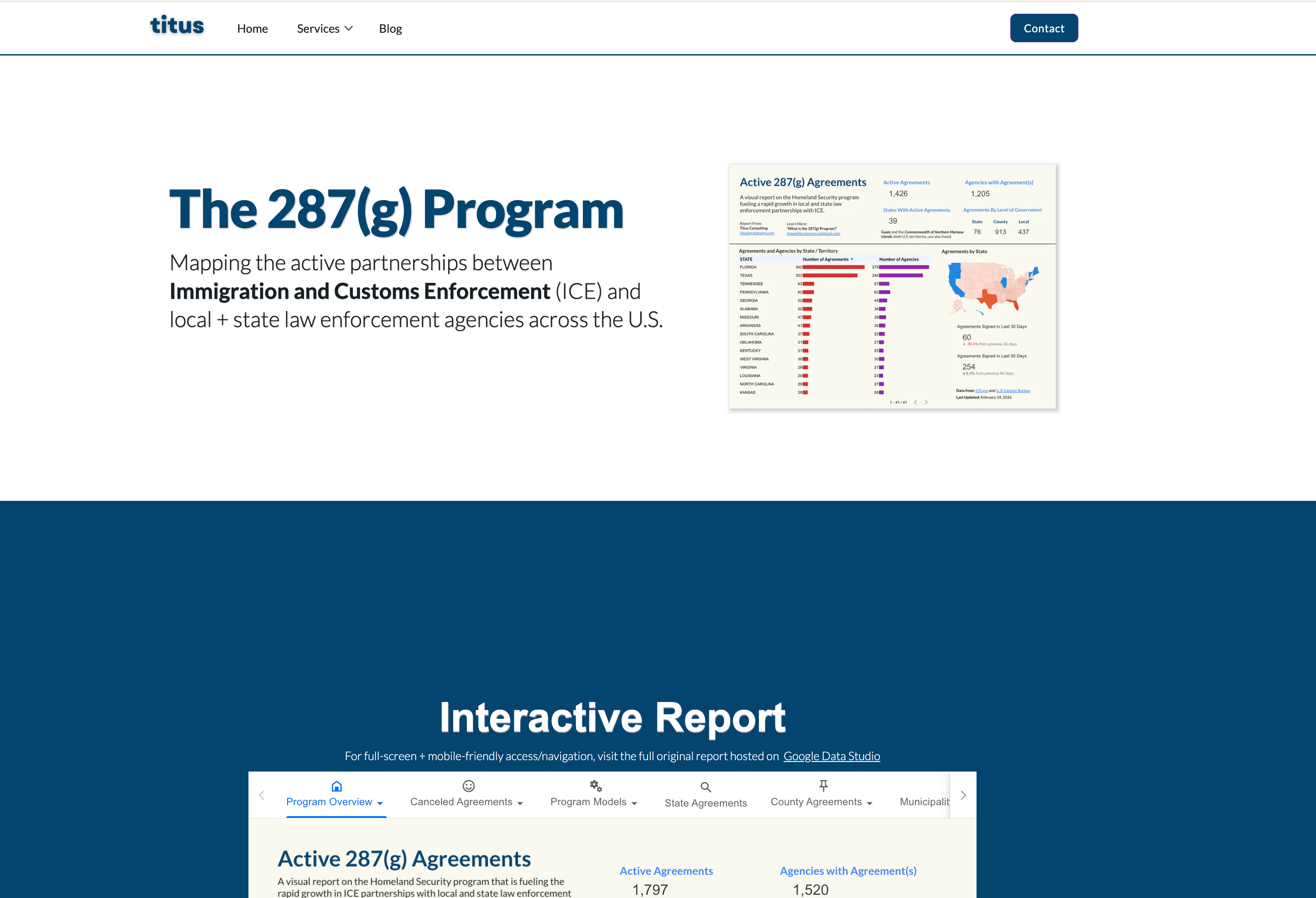
That includes a plain language explanation of how I process ICE’s data for the report and answers to frequent questions. I’m also working on a more formal ‘methodology’ for easy reference + download, in case that’s helpful for journalists or researchers who might find the report useful.
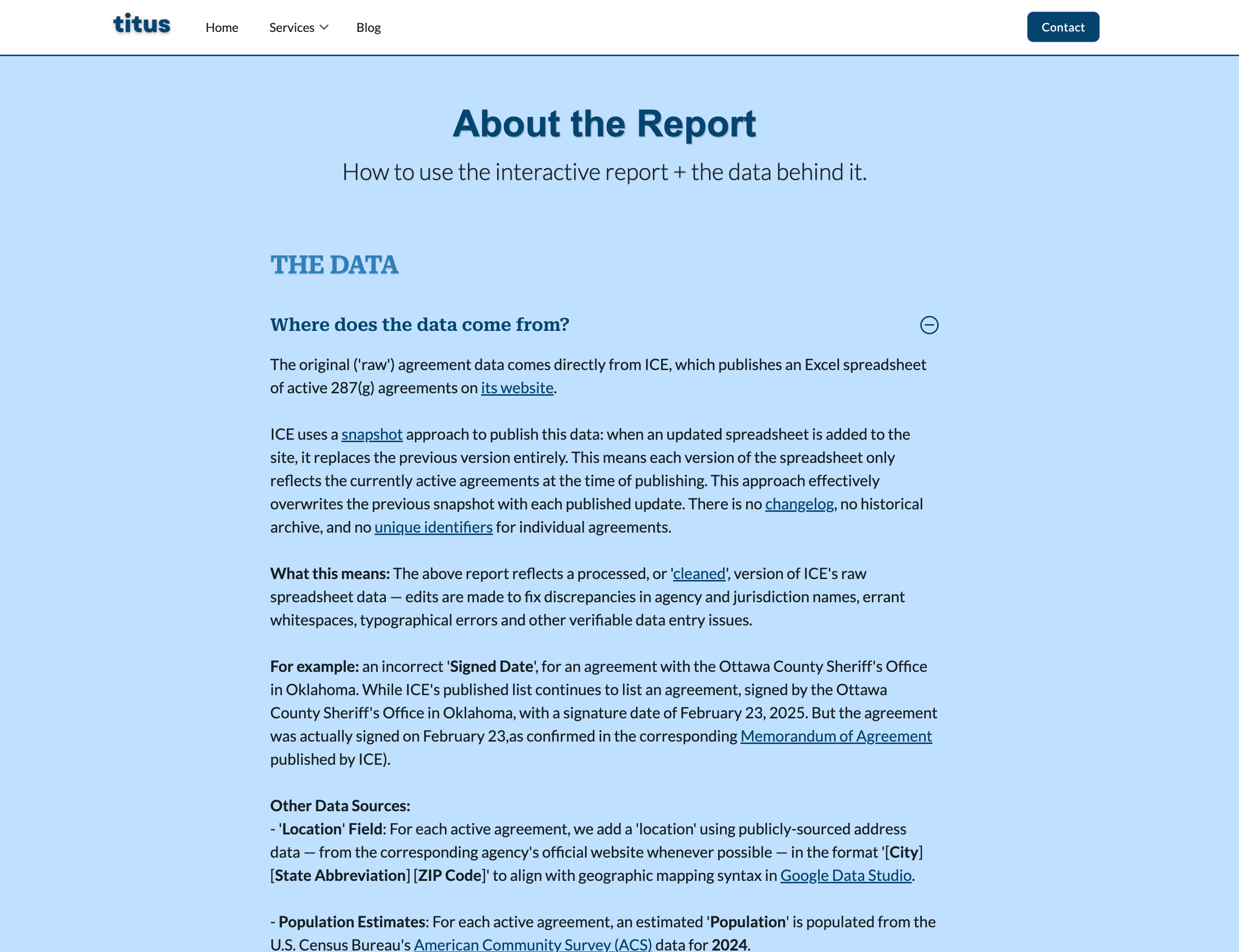
This brings me to an important point, though. A larger refresh will take some time, as it’s just me running this project. There is a lot that I’m actively working to add, including confirmed payments data and more context on the policy decisions (and policy decision-makers) for signed agreements. In the next week or so, I'll have initial DHS payment data added to the report for agencies with have documented payments via the Task Force Model ‘cash cow’ program.

Meanwhile, Dallin Overstreet has been working on a risk calculator for 287(g) policy adoption, based on his policy diffusion research that was recently accepted for publication. I’m hoping we can incorporate Dallin’s risk analysis into the report for more granular forecasting on program adoption.

I only mention this all because it is absolutely true that journalists need to validate their sources, now more than ever. And I have no issue at all with the article’s framing on why this kind of project needs to meet the moment with transparency and accountability.
But this also exposes the White House and Department of Homeland Security for the negligent, lawless manner in which they have managed this multi-billion dollar program with over 1,500 law enforcement agencies across the country.
For example, the screenshot below is the only program visual provided on ICE’s landing page — a static image that is now eight weeks old. This, from a federal law enforcement agency that is effectively operating on a bottomless budget. Apparently DHS’s extensive contracting with Palantir doesn’t include access to a data visualization tool.
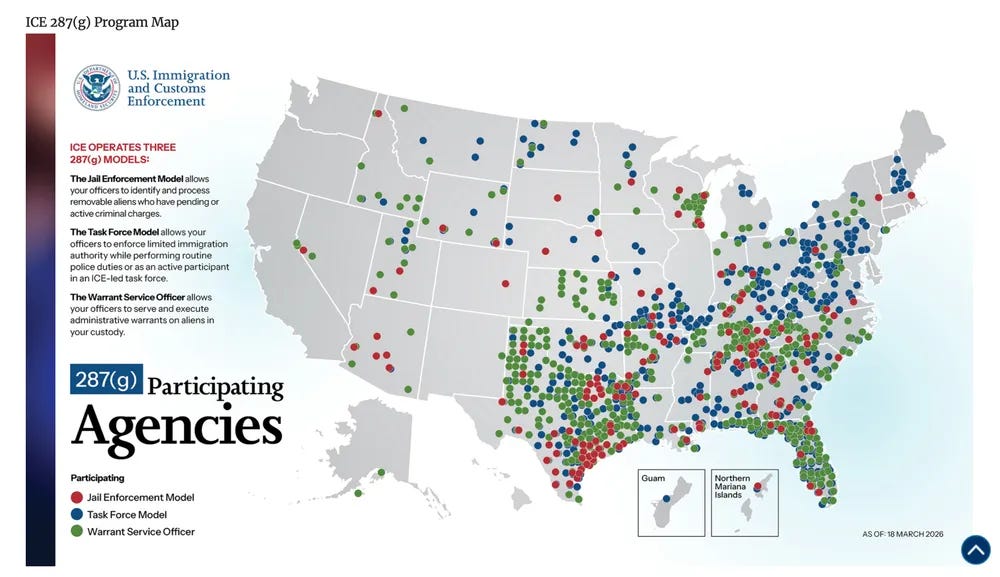
Meanwhile, I’m just a guy with a laptop in Chicago who runs an interactive, visual report to clean up ICE’s messy data for public use. And I do it in between daycare pickups and taking my dog, Titus, for a walk. That’s a problem.
Note: Apologies for the slow content recently. Along with this work, please stay tuned for some non-287(g) content over the next few weeks, including a (long-overdue) breakdown of U.S. Citizenship and Immigration Services (USCIS) and our ‘legal’ immigration system.
Hosted on Google’s Data Studio.
You're providing a valuable service and I've been sending people your way for many weeks. Your addition of the task force payments is an important addition. I'll alert people to that in particular. Thanks for the kind note.