

The 287(g) Program
What Is 287(g)?
The 287(g) program is named after its section of the Immigration and Nationality Act (INA), to which it was added by amendment in 1996. The voluntary program gives Immigration and Customs Enforcement (ICE) the ability to ‘deputize’ local and state law enforcement officers to perform certain immigration enforcement functions.
Civil immigration law is theoretically the federal government’s unilateral domain — from legislation like the INA passed by Congress, to the DHS agencies like ICE and Customs and Border Protection (CBP) that are responsible for enforcing these laws.
Since the first law enforcement agencies actually joined the program in 2002 (in response to the September 11th terrorist attacks), the 287(g) program has represented a murky, and even dangerous, relationship between local police and the federal government.
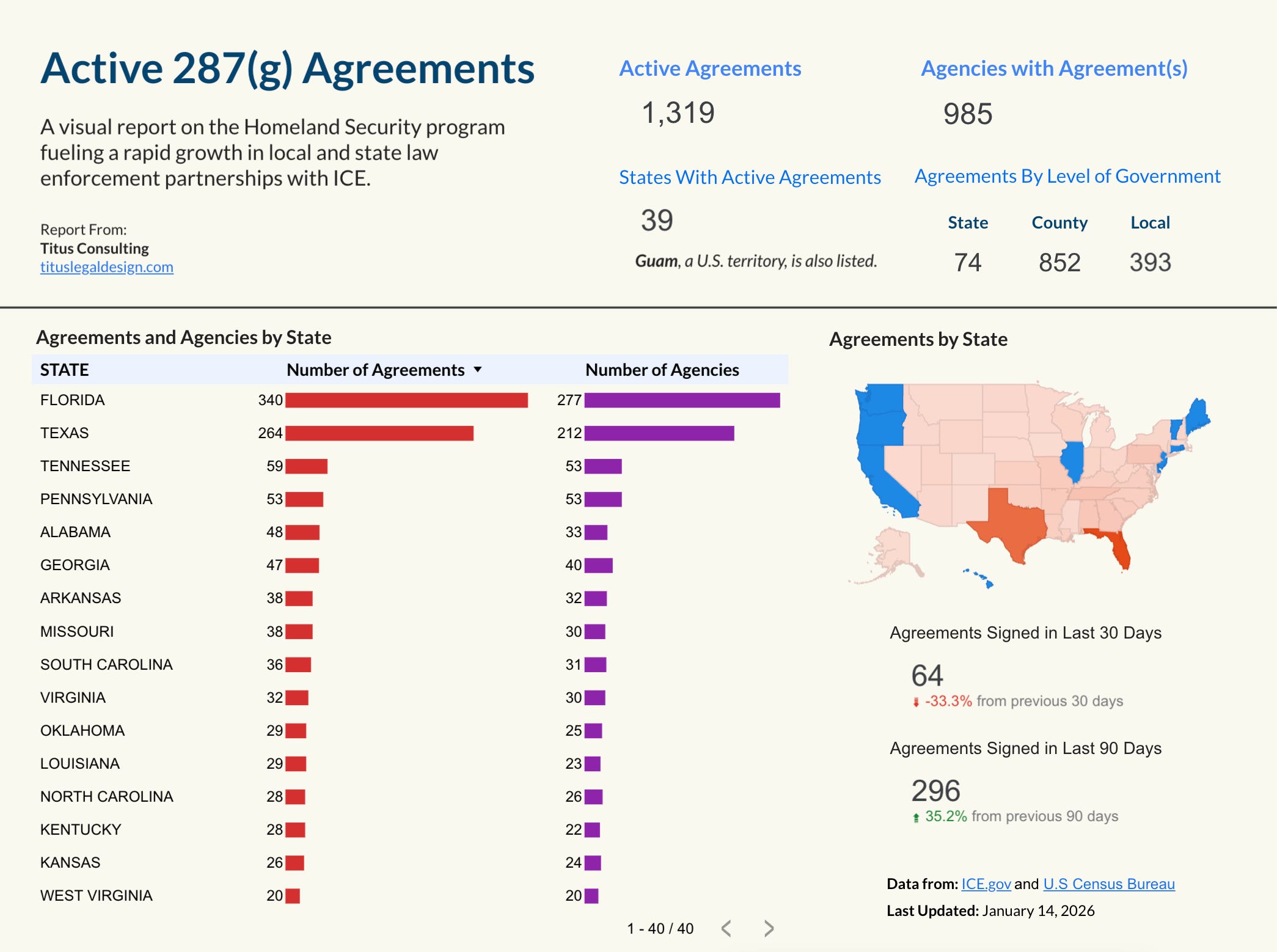
Mapping 1,200 ICE Partnerships: A visual report on the 287(g) Agreement Program

Our new visual report tracks the explosive growth of the 287(g) program and what it means for immigration enforcement and local policing on communities across the United States.
How It Works
Local officers receive training from ICE and are granted limited authority, depending on the program model(s) ⤵️ in which their agency participates.
This can include:
Questioning individuals about immigration status during normal police work and making arrests for suspected (civil) immigration violations.
Accessing DHS immigration databases and surveillance systems (and sharing local data with ICE).
Processing immigration detainers at local and state jails/prisons.1

Three 287(g) Program Models
Task Force Model (TFM):
The most expansive model, and now the most common. Deputized officers can ask about immigration status and make immigration-related arrests during routine community policing: traffic stops, patrols, and other daily encounters.
After it was discontinued in 2012 in response to civil rights concerns and racial profiling, the task force model was revived in January 2025 — and is now the fastest-growing component of the program. Meanwhile, officer training has been compressed from 4 weeks to a 40-hour online course.
Warrant Service Officer Model (WSO):
Designated officers in participating agencies are authorized to serve administrative immigration warrants and transport individuals to ICE custody. Officers under WSO agreements are hypothetically restricted from conducting independent immigration investigations, like asking about immigration status in a routine traffic stop.
Jail Enforcement Model (JEM):
Officers screen individuals already in local custody for immigration violations via federal databases. This model operates inside jails and detention facilities, after someone has been arrested on other charges.
NOTE: Many agencies have multiple active agreements for 2 (or all 3) of the program models to combine jail-based screening with field enforcement powers.
Our Interactive Report
To visualize the 287(g) program’s growth and its geographic and population-based impact, we’ve published an interactive program report using ICE’s published agreements list.
Why You Should Pay Attention
287(g) agreements fundamentally change the relationship between local police and communities in their jurisdiction. When local officers take on immigration enforcement, it:
deters people from calling 911, and reduces cooperation with criminal investigations.
erodes community trust with local police.
uses dangerous and perverse incentives to encourage participation.
places significant legal risk on the local and state governments that participate.

The Police Executive Research Forum, as well as the North Carolina School of Law in conjunction with the American Civil Liberties Union of North Carolina, have also conducted studies of the 287(g) program. They concluded that the program may threaten state and local law enforcement’s relationship with immigrant communities.
The Major Cities Chiefs Association found that “without assurances that contact with the police would not result in purely civil immigration enforcement action, the hard-won trust, communication and cooperation from the immigrant community would disappear.” – Congressional Research Service (2021)
Learn More
Here are some helpful resources to better understand the 287(g) program and how these voluntary agreements work:
Austin Kocher, a professor and researcher who works with immigration enforcement and detention data, including the 287(g) program. Austin is active on Substack, and you can find his 287(g)-tagged posts here.
The Immigrant Legal Resource Center has a great 287(g) explainer, FAQs, and other community resources for local advocates, including this “Immigration Dragnet: The New Era of 287(g)” (July 2025)
To understand how the 287(g) program impacts communities and local sanctuary policies, check out "287(g) Agreements With ICE Threaten Welcoming Communities” from the American Immigration Council.
The Prison Policy Initiative’s analysis of U.S. prison population data includes useful insights on the impact of local and state correctional facilities within the federal government’s mass deportation campaign.
When granting an ICE detainer, a local jailer agrees to temporarily hold an individual’s release from custody, giving ICE several days to pick them up for separate immigration-related violations. Learn more here (ACLU).