

Federal Law, Local Profiling
Destroying trust in the name of bigotry.

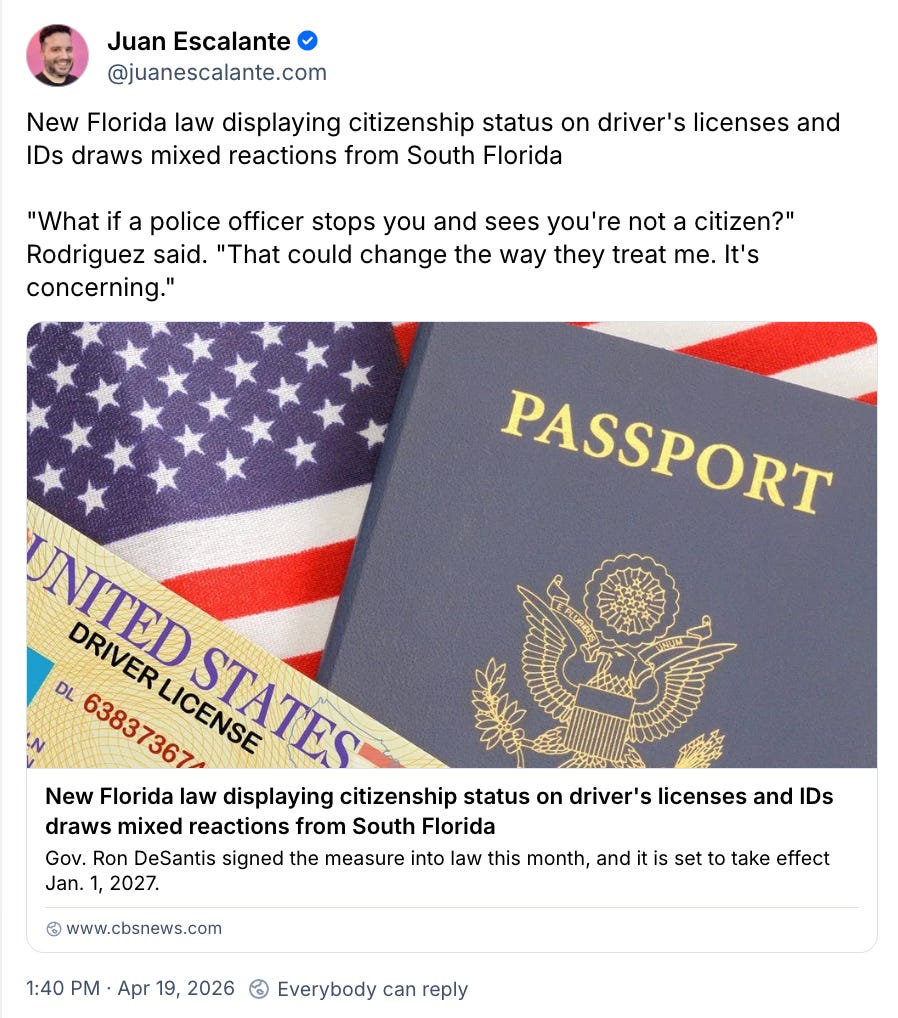
I originally shared this as a thread on Bluesky over the weekend, in response to the following post from Juan Escalante. I figured it’s worth expanding into a short newsletter on this new state ID law in Florida, ICE’s 287(g) program, and the rapid destruction of immigrant communities’ trust in our system of government.
First, if you’re not already familiar with how ICE partners with local and state police, here’s a handy program overview:

ICE’s Local Deputies
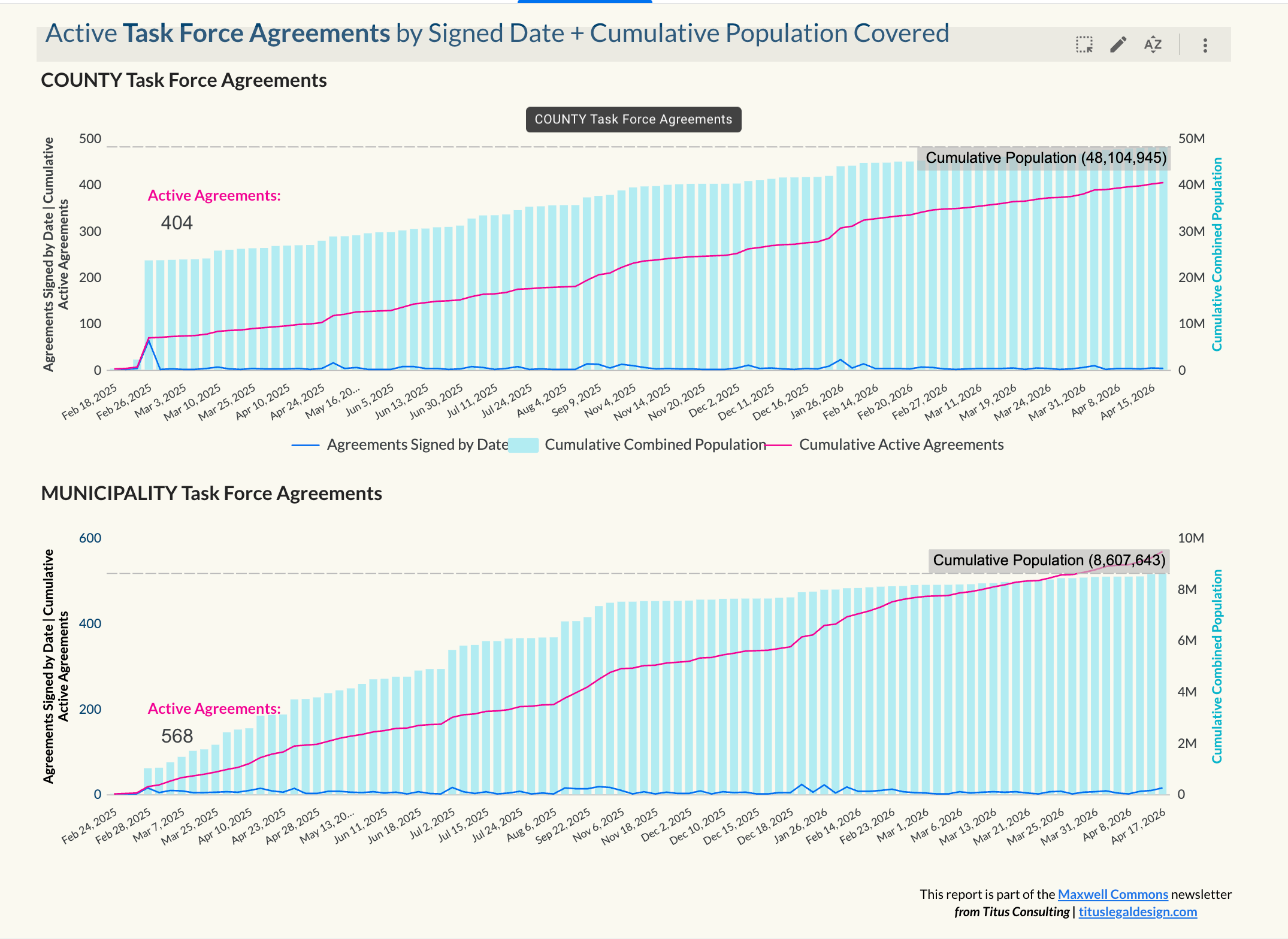
On January 20, 2025, ICE had zero active Task Force 287(g) partnerships.
As of today, April 20, 2026, there are 1,027 law enforcement agencies with an active Task Force agreement. The 404 county-level agencies that participate in this version of the 287(g) program have jurisdiction over a combined population of more than 48 million U.S. residents.
The Task Force model of the program was abandoned in 2012 after the DOJ substantiated civil rights violations, stemming from racial profiling and police misconduct in participating agencies — namely Sheriff Arpaio’s office in Maricopa County, Arizona.
Shortly after the 2025 presidential inauguration, the Department of Homeland Security under the new Trump admin re-established the Task Force version of the 287(g) agreement — and proceeded to build a massive cash incentive system to encourage agencies to join the program. The start of a new 287(g) cash cow for law enforcement, as I’ve referred to it:

Throwing Trust Out the Window
So, how do the 287(g) program and this new ‘status on ID’ law create a dangerous dynamic for the tens of millions of non-citizens living in the United States? Because, to be clear, these policies inevitably impact a much broader population than officials claim, including temporary visa holders and tourists, and green card holders.
Also, citizenship and immigration status are not things your local police should be asking about during a normal traffic stop — just as a prospective employer shouldn’t be asking you what your visa status is during a job interview. Immigration law enforcement is the explicit territory of the federal government, and most immigration violations are civil, not criminal, in nature.
But for people living in a jurisdiction covered by one of the 1,000+ law enforcement agencies with a Task Force agreement, those restrictions are thrown out the window. This is why the massive expansion of ICE’s 287(g) program is so alarming: it’s already rewriting how we view the role of local police in harmful, often misunderstood, ways.
Participating cops are allowed to ask things like “Where are you from?” and “Are you a citizen?” during routine encounters. They’re also allowed to run your info through DHS databases to check for immigration violations, even if you haven’t been detained or arrested. Many of these agencies are also sharing data back to ICE, with little public notice or transparency in what is shared.
From the template agreement on ICE’s website:
The LEA agrees to cooperate with any federal investigation related to this MOA to the full extent of its available powers, including providing access to appropriate databases, personnel, individuals in custody and documents.
Cops who are deputized under a Task Force agreement effectively have the same resources, privileges, interests as ICE — but, crucially, they’re still working as local police. The gun and badge? Issued by local PD. The uniform? Local PD. The cruiser? Local PD. But the scope of law enforcement duties and the immunity protecting these officers? That’s federal.
From the template’s ‘Liability and Responsibility’ section:
Participating LEA personnel will be treated as Federal employees for purposes of the Federal Tort Claims Act, 28 U.S.C. § 1346(b)(1), 2671-2680, and worker’s compensation claims, 5 U.S.C. § 8101 et seq., when performing a function on behalf of ICE as authorized by this MOA. See 8 U.S.C. § 1357(g)(7); 28 U.S.C. § 2671. In addition, it is the understanding of the parties to this. MOA that participating LEA personnel performing a function on behalf of ICE authorized by this MOA will be considered acting under color of federal authority for purposes of determining liability and immunity from suit under federal or state law. See 8 U.S.C. § 1357(g)(8).
Participating LEA personnel named as personal-capacity defendants in litigation arising from activities carried out under this MOA may request representation by the U.S. Department of Justice.
A Recipe for Dangerous Profiling
Similarly, this new Florida ID law will make it easier for police to check someone’s citizenship status, without even asking any related questions. “Can I see your ID and insurance?” is all they need to ask. Stopped for a broken taillight? The cop who pulls you over will know your citizenship status as soon as you hand them your license.
But citizenship status doesn’t actually tell us anything about immigration status, which is why this is a unique recipe for profiling. There are tens of millions of people living and working in the U.S. with valid immigration status and documentation, and tens of millions more without status or documentation. All this does is open the door for citizenship-based profiling and misunderstanding
For the more than 2 million immigrants living in Florida who aren’t naturalized U.S. citizens, their foreign citizenship will be clearly broadcast to anyone checking their ID, whether that’s the police, the cashier at the convenience store, or a bartender.
And the impact extends beyond the state’s border. If you’re a Florida resident and travel to another state where local police are barred from asking about immigration status? You’re still at risk of profiling, simply because of this state ID law.
As we’ve watched our federal government launch a hostile assault against all forms of immigration, we can learn a lot about the local and state leaders in law enforcement and policing who go out of their way to support this effort. In Florida, you don’t have to look far.